 We came to Tankahan for elephants. Tankahan is a small village bound on one side by protected jungle and on the other by a mind-boggling expanse of industrial palm fields. Sarah and I signed up for a day trek, and after a long wait in the sun, six elephants approached from across the river.
 Trek begins: a train of elephants, and we're at the rear. Riding these animals is incredible. Elephants plod, but they are a smooth sturdy ride. SO POWERFUL./ Arguably the most powerful animals on earth, they carried us up steep/rocky mountain slopes without losing momentum the way a horse would. It was less like riding a large horse than riding a noiseless tank. HUGE heaping shits on top of gallons of piss: it really makes you appreciate how prehistorically significant these animals are. At one point, the elephant in front of us ripped a small sapling from the ground with its trunk then immediately flicked it aside as if to say 'whatever'.
 The harem consisted of 6 elephants, 5 females and 1 guy (with the group's first baby on the way). Our elephant was named Sori. At 45, Sori was the matriarch. Guides expect these elephants will live 80 years, which is about 9 yrs longer than the avg Sumatran.
 Afterward, we followed the train down to the river for a bath. No one told you to keep your distance or watch your step and you could walk right up next to them adn pat them on the ass. The females were very tender with each other. On several occasions I watched one tear grass from the side of the trail and feed it to a neighbor. They also did that "holding hands" thing elephants sometimes do.
 A pre-bath ritual: Look closely at the photo. Sori's expression says it all.
 Mark and Lindsay met us here. The elephants had a huge vocabulary and responded to a variety of commands, including what amounted to "lay down", "roll over", "flap your ears", "bellow", and "nail THAT tourist with a powerful blast of water"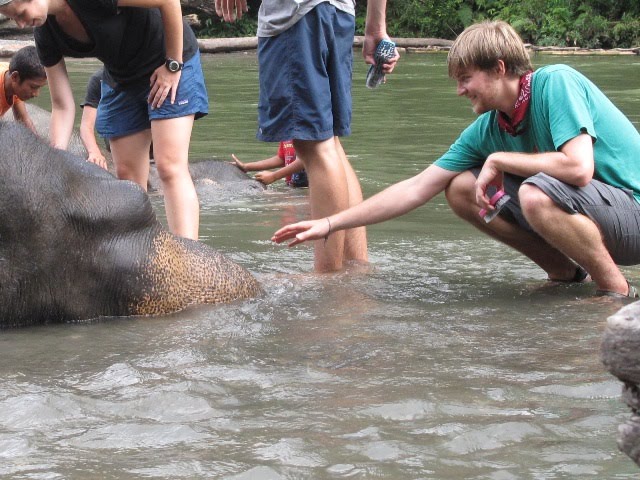

thick craniums, trunks. strange-looking aliens. Elephants communicate in very low frequencies, a vibration you feel in the hairs on your skin. the bottoms of their feet are remarkably flat and round and hard, like bone (like a flat hoof). A trunk has a life of its own-- it'll hit you with small blasts of air then snort in any dislodged scent with a rapid series of inhales. they have a finger-like nub above their nostrils that is also prehensile and can poke around at you. and like apes, when elephants look at you, you can feel their mirror neurons. A very intimate close encounter. That night: No windows in the cabins of Tankahan, just plywood walls and a thatched roof. Sarah and i left the light on inside when we went to dinner and came back to a cloud of insects swirling around above our bed and this BEAST on the wall. The spider was larger than my hand. It's worth clicking on the picture: it's so big its cluster of eyes have that iridescent glow you get when taking pictures of large mammals at night. one of the creeper things I've seen in a while.
Indonesia almost over.
Saturday, September 11, 2010
elephants in Tankahan

Bukit Lawang

The drive from Lake Toba to Bukit Lawang took about 6 hours. we should emphasize that most drives in Indonesia come with a lot of adrenaline. As far as we can tell there are three lanes on roads here: the one you're in, the one for oncoming traffic, and then the dotted line in-between where every vehicle on both sides that isn't a bus plays chicken with the oncoming cars, trying to sneak ahead in trafffic. Worse, it seems the seat belts have (literally) been dis-installed from most cars. Why? we don't know. Bukit Lawang is a small strip along a wide river the color of the Amazon (light brown). it sits just outside a huge preserve in Sumatra that is one of the few places on earth you can still find endemic wild Orangutans, along with many that have been rescued from sad situations and are now being re-acclimated to the wild.
 Orangutans are curious and on several occasions a few came close enough that we could smell them, swinging down on long muscular arms that could pull you apart. In fact there is one orangutan in the preserve named Mina who has (amazingly) attacked over 30 guides in Bukit Lawang, along with some tourists and one guide just a week or so before we got there. Because orangutans are endangered and protected, guides must (amazingly) bear the brunt of these attacks, and many of them have Mina scars as proof. Incidentally, all these pictures are ours (Mina is the one whose face is framed by her baby's limbs).


 During a short break, our second guide, Daydee, aggravated a colony of lemon ants by sliding his lit cigarette into a hole in a root, and again they came pouring out like a scene in some horror movie. speaking of which: according to Umbra-- who confirmed lemon ants taste like lemons-- the jaws are so big on these beasts that locals have used them to suture deep wounds, holding the ant's mandibles over a wound until it bites, then ripping the body away, leaving the head and jaws piercing patient's skin together!!!
 Only one male per troop, so solitary males are common and want very much to fall into line in other simian hierarchies. This one followed us for a while.
  Our guides, Umbra (not pictured) and
  Daydee (blowing smoke next to Sarah (every man in Sumatra smokes)), were very careful about not leaving any scraps around. Pack it in, pack it out, nothing but footprints, etc, etc.
Pictured: a gibbon. Gibbons are heard often, but rarely seen. Small fox-like faces. Loud throaty hoots done in deafening chorus. males adn females have monogamous life-long relationships. Families stick together as one band. Very long arms, and when gibbons move it's like they're falling horizontally through the trees. Lightening fast. They never come down from the canopy. Very shy, keep their distance from humans. Again, a rare sight for tourists, I think. This picture was LUCKY. he was a speck in a tree... zoomed way in after the fact).
About midway through trek, I cut my hand pretty deeply on a vine and half-jokingly asked Umbra if he knew of any plant that would help (lemon ants were not readily available). Within a minute he handed me leaves from a small plant-- a "peacock plant"-- and told me to chew them then rub the resulting paste into the cut. The pain stopped immediately and within 5 minutes the swelling had receded as well--a small reminder that the jungles are our only real drugstore.
It's going to be tough to top our experiences at Bukit Lawang.


Thursday, September 9, 2010
Harau Valley visit


Our bungalow in Harau stood against one of two sheer cliffs in the narrowest part of the valley. Sunlight was limited but the views were astounding, claustrophobic. We heard gibbons hooting immediately after arriving but we didn't see any. The smaller Macaque monkeys were occasionally in the trees, and, as has been the case everywhere in Indonesia, the guesthouse property was overrun with skinny semi-feral cats (especially during mealtime).
It t-stormed each night as the air cooled, and mornings were misty. Everything in Sumatra is bigger than we're used to. For example, the leaves and beetles are so big that you jump when they hit the ground near you. We continue to play a lot of Hearts. Lindsey has a comfortable lead at the moment.
The highlight of the Harau visit was our trek on the second day. A local man named An took us on a trail up the steep cliffs and into the jungle above. this was our first real taste of the jungle adn it didn't disappoint. Going up, we often found ourselves shimmying along ledges or climbing rickety bamboo latters or using vines to let ourselves down slippery embankments (when it rains, as it had the night before, the trail is a stream/waterfall). Several (non-stinging) territorial  wasps followed us, too, and when An jabbed a stick into a hole in a large root at the base of a resin tree, ants the size of your pinky came pouring out. these ants are so big you can pick one up by the "scruff" of its neck and (if you're so inclined) bite off its abdomen, which is about the size of a Skittle and apparently tastes like citrus; the locals call them "lemon ants" and consider them a treat.
Our guide An was full of interesting information. three examples: one, a small fern here closes its leaves when it's touched. you've probably seen these at botanical gardens, maybe even read its unimaginative scientific name. Here in west Sumatra the fern is called "ashamed lettuce", which we think is a pretty excellent name (a close second... the day before, our driver referred to speed bumps as "sleeping policemen").  Second example, An emptied the contents of a pitcher plant ("condom flower" as he called it) into his palm to show us the decomposing ants and mosquitoes inside. The best part about this demonstration was that after talking about it, he carefully poured the juice back into the plant's guts.
 Final example, An showed us a leaf that behaves like Velcro on clothing. you can literally toss the leaf onto someone, and we used the leaves to hide the corporate logos on our tshirts.
Next, An lead us to a hidden swimming hole and we swam. swimming meant jumping in from a horizontal log about 10' above the hole, being careful not to hit a large trunk partially visible just below the surface.
next was lunch (Nasi Goreng wrapped in banana leaves) in a bat cave (hundreds of bats darting about). After lunch we walked through to the other side. Look closely at the photo and you'll see hundreds of little bat eyes illuminated by the flash of my camera. Guano everywhere; locals harvest it.
The trek down was quicker than the trek up, tho some challenging vine action was still required. A really cool hike.

Friday, September 3, 2010
Bukittinggi, stink flower, and a crater lake
 Like many visitors, we decided to use Bukittinggi--a medium size town with about as many mosques as it has city blocks--as a sort of base camp to explore the sights in the highlands of West Sumatra. After several rounds of Hearts and having arranged transport for the following day, we went to bed but were soon woken by the beautiful and eerie and LOUD incantations from the neighboring mosques. Most mosques in Indonesia have several loudspeakers just below the minarets, and because it is still Ramadan, for hours on end all through the night cities fill with the sound of melodic prayer. Throughout this trip, our sleep cycles have been highly contingent on our proximity to local mosques.
The following morning, a friendly young guy drove us (early-to-mid 90's mixtape blasting) to a nearby preserve to see the rafflesia bloom, the world's largest flower and a big tourist pull here. After a 30 minute trek into the jungle, we encountered, first, the enormous phallus of a rafflesia bud and then the amazing flower itself. Its petals are tough and rubbery, like a succulent's, and it stinks of garlic çheese and fermented cabbage. People call it "corpse flower". Like the foul-smelling durian fruit, I think the rafflesia's odor is nature's attempt to mimic rotting flesh, which attracts pollinating flies. Rafflesia bloom once (and only for a week or so), then die, and guides have to keep tabs on where they are sprouting up in the jungle in order to sustain the region's eco-tourism.

Our guide then took us to a nearby woman's house and we drank Civet Coffee, a local specialty. After selecting and eating the best coffee beans, civets (picture a big ferret) digest them using a special enzyme in their stomachs and then shit them out, at which point people collect the beans and grind them into a coffee that, according to connoisseurs all over the world, is really good. None of us thought so, but if you're curious you can order directly from this lady online. we have her card.

Moving on...

After 46 hairpin switchbacks into a crater lake, we arrived at our next destination, Danau Maninjau, a village on the shore of that lake. We rented scooters and did the perimeter. Many segments of hte road (and several houses) are overrun with boulders and mud, evidence of the quake the rocked the area this time last year. Bouncing over the rubble it was perhaps inevitable that one of us would get a flat, and we did. A local fixed it by finding the holes and melting thick pieces of rubber over them then filing it down. the whole process took an hour and cost a dollar.
While we were waiting, a man passed pushing a wheelbarrow full of coconuts with a chained monkey on top. later we watched a different chained monkey climb a palm and twist off coconuts for another man pushing a wheelbarrow. Back at our bungalow, Sarah and Mark swam 30 minutes through wavy water to a small island, and later we chilled with a charming young local boy named Yogi, who showed us magic tricks.

We were virtually the only tourists Danau Maninjau, and this will become a theme for the remainder of Sumatra as well. Many touristy things now defunct. A combination of a string of natural disasters and the sinking world economy has left much of Sumatra with far fewer visitors than before. we see evidence of this everywhere.
Thursday, September 2, 2010
Visas in Singapore
 We flew into Singapore for one night in order to renew our visas for our final two weeks in Indonesia. Our customs ticket warned that drug traffickers would be put to death. Singapore is a republic and since 1959 has functioned as a city-state. About 5 million people live there, a huge mix of ethnicity and religions. It is one of the most productive ports in the world, which its rising skyline and weirdly modern architecture appears to be advertising.
Drug-trafficking aside, we'd read Singapore has famously steep penalties for transgressions like spitting (a tourist was recently caned), j-walking, smoking in smoke-free zones, public peeing (apparently some elevators have "sniffer alarms"), littering ($500), and not flushing a public toilet (enforceable?)... But of course it is all utterly overblown. Everyone j-walks, many smoke, public restrooms are like public restrooms everywhere, and stores openly burn their trash on the sidewalk. Moreover, the people we encountered were relaxed, friendly, and as cosmopolitan as any other place we'd been in Asia.
It was brutally hot that day, and we each learned mid-90's humidity doesn't mix so well with all-you-can-eat Indian buffets. Mark learned the lesson especially well. However, by evening things had cooled down and the skyline began to gleam. One of the more interesting architectural feats in Singapore is the Marina Bay Sands. Completed in June, it looks like a giant version of the AT-AT walker from Star Wars or some futuristic noah's arc. Sarah and I took an elevator to the top (almost 60 stories), where there is an sprawlin wooden deck, trees and a grass garden, and possibly the most amazing vanishing pool on Earth (for hotel guests only). The opening ceremony to the International Youth Olympic games happened to be going on that night and at 10pm the ceremony concluded and we were treated to fireworks, which we watched from above, which was cool.

 Early the following morning we would head by boat and plane to Sumatra.